"Send out Your light and Your truth, that they may lead me, and bring me to Your holy hill and to Your dwelling." Psalm 43:3
Showing posts with label Daily Office. Show all posts

Saturday, March 8, 2014

"That the love wherewith Thou didst love Me may be in them"

"And I have made Thy name known to them, and will make it known; that the love wherewith Thou didst love Me may be in them, and I in them."
~ John 17:26

From today's Daily Office reading, the closing verse of the seventeenth chapter of the Gospel according to Saint John, our Lord's "High Priestly Prayer".  Jesus has revealed the Father to us, and will continue to reveal Him more and more, according as the Spirit of Jesus is within us.  Both the means and the end of this revelation is nothing less than invitation into the love that is the very life and substance of the Triune God.


Peace of Christ.

Wednesday, October 9, 2013

Devotion and Ritual in an Episcopal Home

Hear, O Israel!  The LORD is our God, the LORD is one!  And you shall love the LORD your God with all your heart and with all your soul and with all your might.  And these words, which I am commanding you today, shall be on your heart; and you shall teach them diligently to your sons and shall talk of them when you sit in your house and when you walk by the way and when you lie down and when you rise up.                                                             ~ Deuteronomy 6:4-7

Does the Episcopal Church actively foster a culture of Christian devotion?  Are Episcopalians expected and encouraged to have meaningful devotional lives?  Do we have recognizable daily rituals that enhance our faith and help us to grow in Christ?  I've been wondering over this for some time.  It was a blog post over at Episcopal Journey of Hope which finally impelled me to get some thoughts written down.  In that post, the author talked about hearing a radio spot sponsored by the Jewish Federation that was encouraging its people to "come back, learn the rituals, and participate in our programs."  This prompted the author of the post to ask "What are our rituals (as Episcopalians)?  How do they identify us?"  These are great questions, and to my mind, important ones.  I think there are faith communities that do effectively model and encourage this idea of "religion in the home", that is to say, faith as integrally woven into the daily life of the believer.  Unfortunately, I'm not sure my Episcopal Church is one of them.    

I begin with a look at the Jewish tradition. There are two broad aspects of the rituals of the Jewish shabbat that stand out to me.  First, as I understand it, it is traditionally a ritual largely presided over by the wife/mother, and so provides a sort of balance to the male leadership/prominence of the traditional synagogue.  The other is that the ritual is in the home.  So, there is this lived reality that the whole family, men, women, and children, have important roles to play, and that these beliefs are not something simply acted on occasionally in public, but rather form the fabric and rhythm of private and family life.


I think the Eastern Orthodox and Roman Catholics do a pretty good job at this.  Every Orthodox home has (or is expected to have) an icon corner, a carefully prescribed sacred space within the home.  Among Roman Catholics, I have read about and experienced personally the concept of "the Domestic Church" -- the home as a smaller reflection of the community of the Church (e.g. husband/father as 'priest' of his home), and I think one would be hard-pressed to find a Roman Catholic home that didn't have, to a lesser or greater degree, prominent images of Christ, the Virgin Mary, crucifixes, rosaries, etc.  You know when you're in a Roman Catholic home.

Christians of a more evangelical stripe are certainly expected to live out their faith in daily life, and recognize that it's difficult (if not impossible) to do so without a conscious effort to develop their relationship with Jesus.  A defining characteristic of the evangelical culture is the assumption that Christians will be actively seeking to develop their faith outside of Sunday morning, both in small groups (Bible studies, cell groups, etc.) as well as individually.  In order to maintain "a personal relationship with Jesus", you need to "get into the Word" in your "daily devotions" or "quiet times", and so be "equipped to grow spiritually in your Christian walk."  These stock phrases of evangelical pastors may sound cliche to some, but they represent an exhortation to a way of life, not just a Sundays only affair.
 

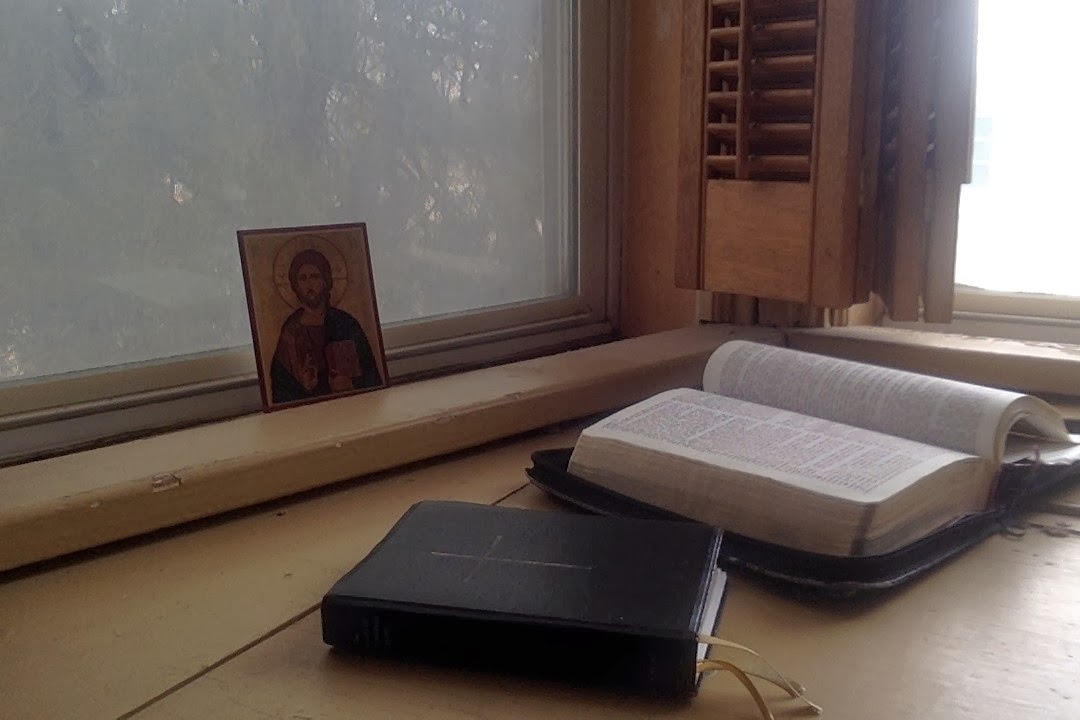
I think this is all critically important.  No matter how vibrant one's church, I think it is very difficult to grow spiritually or to raise children in the faith without deliberately and sincerely implementing some level of devotion or ritual into one's daily life.  My concern is that perhaps we Episcopalians (as a whole) don't do this very well.  If this is true, it's the more pitiable in that this concern to provide the laity with a simple yet rich pattern for a Christian devotional life was one of the guiding principles in the creation of the Book of Common Prayer.  And, as a resource, our Prayer Book does this beautifully.  In my home, we have an icon prayer corner, where we keep our Bibles, prayer books, and other devotionals.  It's here that I pray the Daily Office (or attempt to with some consistency, at any rate), and where we have thrice-weekly family devotions, using a form of Compline modified for the use of little ones with short attention spans.  These devotions include the ritual of candle lighting and incense burning ('let my prayer be set forth in your sight as incense, the lifting up of my hands as the evening sacrifice').  Again, I think such a living into our faith and traditions in a way that daily shapes us and models for our children the integral nature of that faith is vital.  However, it was not primarily from my church family that I received such encouragement and instruction, but rather from my being raised by evangelical Episcopal parents, and from the influence of Orthodox and Roman Catholic friends.


I hope I'm wrong in thinking that we don't do a good job at this; maybe it's just my own limited experience.  As Episcopalians, do we expect our people to have lives of daily devotion and meaningful ritual?  Do we instruct and provide direction to that end?  If you were in the home of a parishioner, would you know, without having to ask, that this is an Anglican (or even merely Christian) home?

May God the Father, who by Baptism adopts us as his children, give us grace. Amen.
May God the Son, who sanctified a home at Nazareth, fill us with love. Amen.
May God the Holy Spirit, who has made the Church one family, keep us in peace. Amen.
                                                                                                                                                                                                ~BCP pg. 445


Friday, March 15, 2013

Echoes of Jeremiah

"For wicked men are found among my people ... They are fat, they are sleek, they also overlook deeds of wickedness; they do not plead the cause, the cause of the orphan that they may prosper; and they do not defend the rights of the poor.  Shall I not punish these people?" declares the LORD, "On a nation such as this shall I not avenge myself?"
"An appalling and horrible thing has happened in the land: the prophets prophesy falsely, and the priests rule on their own authority; and My people love it so!  But what will you do at the end of it?"
~Jeremiah 5:26a, 28-31

Thus says the LORD of hosts, the God of Israel, "Amend your ways and your deeds, and I will let you dwell in this place.  Do not trust in deceptive words, saying, 'This is the temple of the LORD, the temple of the LORD, the temple of the LORD.'  For if you truly amend your ways and your deeds, if you truly practice justice between a man and his neighbor, if you do not oppress the alien, the orphan, or the widow, and do not shed innocent blood in this place, nor walk after other gods to your own ruin, then I will let you dwell in this place, in the land that I gave to your fathers forever and ever.  
"Behold, you are trusting in deceptive words to no avail.  Will you steal, murder, and commit adultery, and swear falsely, and offer sacrifices to Baal, and walk after other gods that you have not known, then come and stand before Me in this house, which is called by My name, and say, 'We are delivered!' -- that you may do all these abominations?  Has this house, which is called by My name, become a den of robbers in your sight?  Behold, I, even I, have seen it," declares the LORD.
~Jeremiah 7:3-11

This Lent, the Daily Office lectionary has been taking us through the book of Jeremiah.  The above passages are but two examples of a theme that runs all through the book.  Judah is being condemned for two great sins:  committing injustice toward the poor and oppressed, and turning away from the LORD after other gods. It seems to me that both are a problem in the Church today, though in different places, as it were.  (I am aware that in what follows, I am speaking in generalities; there are always exceptions to the rule.)

Mainline Protestant churches, such as my own Episcopal Church, have for some time had a distinct emphasis on seeking to promote and uphold social justice.  This is as it should be.  But in some cases, that emphasis has become so central that it has pushed orthodox doctrine to the side, as a thing secondary, or even unimportant (and in some instances, incredibly, basic tenets of Christian doctrine are viewed as problematic, something to be gotten rid of).

Some more 'conservative' churches, such as the many evangelical and non-denominational fellowships, have done well in seeking to remain faithful to God in the midst of a secular society that is increasingly unabashed in expressing scorn for the scandalous and exclusive claims of Christ and His Church.  But these same churches can be guilty of inadequately addressing the needs of the suffering, poor, and outcasts, since we seek another country, and anyway the poor you will always have with you.

I think in order to be the Church, we must duly attend to both concerns.  According to the Catechism of the Episcopal Church, "The Church is the community of the New Covenant.  The Church is described (in the Bible) as the Body of which Jesus Christ is the Head and of which all baptized persons are members" (BCP, pg. 854).  This then, is our identity.  It is found, fundamentally, in the person of Jesus Christ.  To move away from this identity, to relegate or downgrade as non-essential the basic doctrine of the catholic, apostolic faith, is to cease to be the Church and to become simply another charitable organization.  Such an organization may draw its inspiration from the example of a really good guy who showed us how we should live, but it is also an organization that, frankly, is not nearly so efficient as some other entities that also exist to address issues of social justice and the common good.  Social justice is not the definitive mark of the Church, but is rather an essential outgrowth of our identity as a community that has been brought, and is ever growing more, into unity with God in Christ.  In the words of the Catechism, "The mission of the Church is to restore all people to unity with God and each other in Christ."  Certainly, working for social justice is integral to bringing people into unity with each other, but I think this distinction between the identity of the Church and the mission of the Church is important; we must not put the cart before the horse.  However, where the mission is not being pursued, I think we may justly question the authenticity of the identity.  We should keep James's biting criticism of faith without works ever before us: If a brother or sister is without clothing and in need of daily food, and one of you should say, 'Go in peace, be warmed and be filled,' and yet you do not give them what is necessary for their body, what use is that?  And our Lord himself reserved His harshest condemnations for those 'Pharisaical' hypocrites, of whom Isaiah prophesied, This people honors Me with their lips, but their heart is far from Me.

Admittedly, this is difficult.  The call to live faithfully as the Church Militant always will be difficult, but we have the consolation that God is in our midst, and through Christ we can do all things.  May He give us grace both to hold fast to Him, our first love, and to ever "strive for justice and peace among all people", faithful in  the ministry of reconciliation that has been entrusted to us.

Gracious Father, we pray for thy holy Catholic Church.  Fill it with all truth, in all truth with all peace.  Where it is corrupt, purify it; where it is in error, direct it; where in anything it is amiss, reform it.  Where it is right, strengthen it; where it is in want, provide for it; where it is divided, reunite it; for the sake of Jesus Christ thy Son our Savior.  Amen. 
       

Friday, February 22, 2013

Lead Us Not Into Temptation

Almighty God, whose blessed Son was led by the Spirit to be tempted by Satan: Come quickly to help us who are assaulted by many temptations; and, as you know the weaknesses of each of us, let each one find you mighty to save; through Jesus Christ your Son our Lord, who lives and reigns with you and the Holy Spirit, one God, now and forever.  Amen.
~Collect for the First Sunday in Lent


Last Sunday, we heard St. Luke's account of how Jesus was "led about by the Spirit in the wilderness for forty days, being tempted by the devil."  The Daily Office readings from the Letter to the Hebrews for this week have built upon this theme.  In chapter two, the writer to the Hebrews says, "Since then the children share in flesh and blood, He Himself likewise also partook of the same, that through death He might render powerless him who had the power of death, that is, the devil ... for since He Himself was tempted in that which He has suffered, He is able to come to the aid of those who are tempted."

Saint Augustine writes,
Our pilgrim life here on earth cannot be without temptation for it is through temptation that we make progress and it is only by being tempted that we come to know ourselves.  We cannot win our crown unless we overcome, and we cannot overcome unless we enter the contest, and there is no contest unless we have an enemy and the temptations he brings. (Discourse on Psalm 60)
I think these words have particular power today, at a time when many, even within the Church, are reluctant to speak of either sin or the devil.  Given that the Church in times past has, in my opinion, sometimes overemphasized the same makes this understandable, but not justified.  For it is indeed hard to separate sin (not simply vague, impersonal corruption in which we are stained by association, but personal, willful evil which I myself commit) and the devil (not just a personified symbol of evil, but a spiritual reality, an enemy against whom we wage battle by the grace and in the power of Jesus) from the New Testament, and the Gospels in particular.  I'm reminded of H. Richard Nieburh's famous criticism that "A God without wrath brought a people without sin into a kingdom without judgment through the ministrations of a Christ without a cross."  Incidentally, praying the Great Litany (BCP, pg. 148-155) is a good antidote for this kind of delusion.

But lest, while being "assaulted by many temptations", we start to get discouraged, we do well to bear in mind that this battle has already been won.  The good news is that Christ has already overcome the world, and He that is now within us who believe is greater than the evil one.  Augustine continues:  
When he willed to be tempted by the devil, he figuratively transferred us into himself.  We have just read in the gospel that our Lord Jesus Christ was tempted in the desert by the devil and this is exactly what happened.  In Christ you were being tempted because Christ had his human flesh from you, just as he won salvation for you from himself.  He received death from you, just as he gained life from himself for you.  From you he received reproaches and from himself for you he gained glory and honour.  In the same way he suffered the temptation for you and he won from himself the victory for you.  If we have been tempted in him, in him we conquer the devil.  Do you notice that Christ has been tempted and fail to notice that he overcame the temptation?  Recognize your own self, tempted in him and conquering also in him.  He might have avoided the devil completely but, had he not been tempted, he would have failed to give you the lesson of conquering when you are tempted.
So, in this, as in all things, we have in Christ our supreme example. But more than an example, by Christ's Incarnation, we have become joined to Him by faith. He takes our weaknesses and transfers to us His victory. "For we have become partakers of Christ, if we hold fast the beginning of our assurance firm until the end" (Hebrews 3:14). It is because of this that we live in victory, even as we acknowledge in this penitential season of Lent that "our pilgrim life here on earth cannot be without temptation." As the writer to the Hebrews assures us in closing chapter four,
Since then we have a great high priest who has passed through the heavens, Jesus the Son of God, let us hold fast our confession.  For we do not have a high priest who cannot sympathize with our weaknesses, but one who has been tempted in all things as we are, yet without sin.  Let us therefore draw near with confidence to the throne of grace, that we may receive mercy and may find grace to help in time of need.

Peace.

Saturday, February 9, 2013

Responding to the Call, and Believing What We Pray in the Magnificat

My soul proclaims the greatness of the Lord,
my spirit rejoices in God my Savior;
     for he has looked with favor on his lowly servant.
From this day all generations will called me blessed:
     the Almighty has done great things for me,
     and holy is his name.
He has mercy on those who fear him 
     in every generation.
He has shown the strength of his arm, 
     he has scattered the proud in their conceit.
He has cast down the mighty from their thrones,
     and has lifted up the lowly.
He has filled the hungry with good things,
     and the rich he has sent away empty.
He has come to the help of his servant Israel,
     for he has remembered his promise of mercy,
The promise he made to our fathers,
     to Abraham and his children for ever.

I am currently reading On Being a Priest Today, by Rosalind Brown and Christopher Cocksworth.  In Chapter 3, "On Being for God", the authors begin by referencing the call of Moses, "the father of ministry by grace through faith."  When confronted with the call of God in the Burning Bush,
Moses' response was archetypal, echoed throughout the generations of calls to ministry: 'Who am I that I should go?' (Exodus 3:12).  God's reply to Moses is equally foundational and remains the word to all who have been called: 'I will be with you; and this shall be a sign for you that is I who sent you: when you have brought the people out of Egypt, you shall worship God on this mountain' (Exodus 3:12).  Moses' response is a statement of his own weakness.  God's response is a promise of his presence -- a promise that will be known to be true only in its believing, only in obeying the call, only in the doing of ministry.
The authors point out that it is Moses' very recognition of his own unworthiness that validates the call of God on his life.  It is true that Moses, in himself, is not fit to fulfill such a high and holy calling; no one is.  It is when an individual realizes this, however, that he or she is fit to be used as an instrument of God, through which He will accomplish great and wondrous things.  If Moses is the father of ministry by grace through faith, the Church may justly look to Mary as the Mother of all who say 'yes' to God.  Brown and Cocksworth continue:
Moses' song exalts the Lord as the true God who is able to accomplish the unexpected.  It is the same key in which Hannah, Mary, and other biblical characters sang.  'There is no Holy One like the Lord, no one besides you,' sings Hannah, no one 'raises up the poor from the dust' and makes the 'barren bear seven children' (I Samuel 2:2).  Mary's soul, too, 'proclaims the greatness of the Lord' who has 'looked with favor on his lowly servant' (Luke 1:46-48).  The Daily Office invites us to sing these familiar words of the Magnificat each evening as we gather the day before God in prayer.  The day may have felt very unproductive.  The powerful forces of the world may have seemed secure on their thrones and we, feeble against them.  But the theological truth in the strange kenotic workings of God is that even on this day, when our ministry has seemed at its most barren, God has done great things for us and through us, simply because, with Mary, our faith has said 'Here am I, the servant of the Lord' (Luke 1:38).  
Be encouraged, for my Father and your Father is working until now, and Jesus has overcome the world!
Peace.
     

Wednesday, December 5, 2012

Reflections on Isaiah Chapter One

Therefore, the Lord GOD of hosts,
The Mighty One of Israel declares, 
"Ah, I will be relieved of my adversaries,
And avenge myself on my foes.
I will also turn my hand against you, 
And will smelt away your dross as with lye,
And will remove all your alloy.
Then I will restore your judges as at the first,
And your counselors as at the beginning;
After that you will be called the city of righteousness,
A faithful city."
~Isaiah 1:24-26

A couple of things in this passage grabbed my attention during Evening Prayer yesterday.  First, God fights His own battles.  Second, He purifies His unfaithful people (a painful process) in order to bring them again to a place of faithfulness.

Regarding the first observation, I'm reminded of Archbishop Michael Ramsey's words: "Whenever exponents of the Christian faith treat it as something which we have to 'defend' like a beleagured fortress or a fragile structure they are making God to be smaller than he is."  These words resonate with me, as I observe the incessant "culture wars" into which many Christians continue to insert themselves.  I presume that they do so with the best of intentions, but I have felt for some time now that this does more harm than good.  I don't hear many people these days saying, "See, how these Christians love one another!", but rather wondering what piece of controversial legislation we will support or oppose next.

In times such as these, I tend to gravitate toward the words of wise Gamaliel in Acts chapter 5.  When the Sanhedrin is considering how to respond to the "threat" of the preaching of Peter and the apostles, Gamaliel counsels, "Stay away from these men and let them alone, for if this plan or action should be of men, it will be overthrown; but if it is of God, you will not be able to overthrow them; or else you may even be found fighting against God."  Sounds like good advice to me, given the disrepute which we have brought upon the Church in the eyes of so many by now openly aligning ourselves with this political messiah, now taking our stand on this issue upon which the very existence of our civilization depends, now railing in the name of God against this cultural shift.  Unfortunately, no sooner do I settle comfortably into Gamaliel's advice, confident that I have chosen the better way, than I am reminded of the oft-quoted words of Edmund Burke: "All that is needed for the triumph of evil is for good men to do nothing."  Well, shoot.  Those words resonate with me as well, though in a way that weighs uncomfortably on the shoulders of my timid, be-at-peace-with-all-men soul.  I think of men like William Wilberforce, Dietrich Bonhoeffer, Martin Luther King, Jr., Archbishop Desmond Tutu, and many others.  I think of the prophet Amos, who cried out, "Hate evil, love good, and establish justice in the gate!"  So, how to remedy this conflict between simply trusting in the ultimate triumph of God's truth and the duty of publicly aligning myself with that truth?  How do I quietly and peacefully "leave room for the wrath of God" while also faithfully proclaiming God's truth in the face of sin and injustice?  Well, the answer is ... ha! yeah, I don't know.  But I'm trying to find that place.

Something I can say with confidence, though, is that the Christian life is a life of hope.  Even in suffering and hardship, when the walls are crumbling, when it seems that we have been abandoned, the Christian lives in hope.  It may be that this time of pain and uncertainty is "the smelting away of (our) dross."  For myself, I think of the on-going struggles within Anglicanism.  I don't know how the shape of the Church will change in the years to come, and things certainly can look bleak at times, but I am convinced of the never-failing love and faithfulness of God, who is ever purifying and renewing His people, that we may be "a faithful city".

Peace.  

Sunday, July 29, 2012

Incarnational Theology and Praying the Anglican Rosary

O God, who wonderfully created, and yet more wonderfully restored, the dignity of human nature: Grant that we may share the divine life of him who humbled himself to share our humanity, your Son Jesus Christ; who lives and reigns with you, in the unity of the Holy Spirit, one God, for ever and ever. Amen.
~Various Occasions, Collect no. 4: Of the Incarnation

Among the things that I have been learning in my readings over the last year or so, one recurring idea is that of the Incarnation as central to the Anglican identity and understanding of the faith.  The results of recognizing Incarnational theology as the foundation of the faith are many and significant.  One result for me has been an embracing of the tangible and physical as redeemed and good.  This is a desire that has always been present in me (and, I think, in humanity generally), but was for years tempered by my Protestant upbringing.  I read a statement a while back about the latent and unacknowledged Gnosticism that pervades much of Protestantism.  It is the dualism of the Gnostic that says, "The spirit alone is good, the flesh is evil."  Many Protestants would not baldly make such an extreme assertion in their theology (some would), but the results are manifest nonetheless.  Compare the sparse, utilitarian "meeting house" of the Protestant with the glittering, liturgy-steeped cathedral of the Catholic.  "Bah, rags of Popery!  Enticing and deceiving the ignorant masses with all those 'smells and bells', the sensuality of it all!"  To which the catholic Christian answers, "Christ has come and fully embraced our humanity, our earth and time-bound existence.  God became man, was born, lived as one of us, died, and was reborn out of death.  In so doing, He has hallowed our humanity, and all creation with us.  As it was in the beginning, so it is now again: 'It is good'."

Now, it is obviously true that we still live beset by the corruption of this fallen world and must continually "persevere in resisting evil"; to suggest otherwise is to be blind to the daily reality of sin, to look on evil and claim that it is actually good and we just don't yet recognize the goodness (what C.S. Lewis called "talking damned nonsense").  I am not advocating a feel good theology that refuses to acknowledge that there is evil in the world; yet the great work of redemption has been accomplished already. Christ the second Adam has reconciled humankind to God by becoming one of us, and through an act of entire self-giving has filled all in all.

And so, out of the goodness of His creation, we bring Him the best we can offer.  Yes, we seek to move beyond the purely temporal as we draw nearer to God in Christ, but we do not reject the temporal in the process.  God did not redeem us by rejecting the temporal to affect our salvation by some purely spiritual act "somewhere out there." He came to us in the here and now.  It is here and now that we exist, and so we worship with our bodies as well, with our minds, with our voices, with our gifts, be they literary, musical, architectural, etc.  We bring all we are before God as an offering.  And we glorify Him in the here and now, where He has placed us to be a channel of His Love in the midst of this physical Creation.

A simple example of this embracing of the tangible is the use of prayer beads, a tradition that stretches back centuries through the saints.  I ordered mine online from the Solitaries of DeKoven; one of the hermits makes them as a ministry and form of livelihood for the order; each one is crafted in prayer.  I've been using them in my times of personal prayer for about a month now.  I also just read a small book (a pamphlet, really) by Lynn C. Bauman entitled The Anglican Rosary.  The book consists primarily of sample prayers, which also serve as examples to inspire the reader in composing their own prayers.  But it also includes an introduction to the history of the Rosary, and an explanation of its symbols.  The Anglican Rosary is rife with symbolism, much of it focused on numbers which have deep significance in Scripture: the circle of the beads represents eternity, even while our praying through the cycle of beads mirrors our earthy pilgrimage; the four cruciform beads make the symbol of the cross; the four "weeks" or series of seven beads make up the majority of the prayers, recalling the seven days of creation, and the seven seasons of the church's liturgical year; the rosary is prayed through three times, bringing the number of cruciform prayers to twelve; the total number of beads is thirty-three, the number of years of Christ's earthly life; and on and on.


In many ways, the Rosary also mirrors the liturgical year of the church, which is itself an acknowledgement of the redemption of the created order, the seasons which govern our life.  But in the liturgical year, the church consciously marks time by a recognition of the sacred, the major events of that supreme event, the life of Christ.  In so doing, we are able to see the deeper truths to which the whole created order points.  I think Bauman sums this up beautifully.  For example, she writes:

"Because the seasons of the Liturgical Year are strategically placed around the four cardinal points of the solar year, we can more easily grasp their spiritual significance.  For example, the Feast of Christmas falls on and replaces the ancient feast of Winter Solstice, the longest night of the year, when the Sun makes its turn back toward the longest day.  This ancient, pagan feast signified the birth of Light into the world and the return to light from darkness.  It is fitting, therefore, that Christmas should be celebrated here as well, since it stands for the birth of the Divine Light into the great darkness of the world.  Another example, Easter falls on or around Spring Equinox when light 'conquers' darkness, so to speak, and the days are now longer than the night.  Pentecost is celebrated on or near the Summer Solstice, the longest and brightest day of the year.  Briefly then we can understand the spiritual symbolism inherent in each season."

Another point Bauman makes is that we can view praying the Rosary as "a little office".  This has been especially helpful to me.  I love to pray the daily office (using the rites in The Book of Common Prayer), but since the arrival of our third child, this is not always easy.  Very often the times when I have opportunity to pray are times that I am holding a little one in my arms.  Viewing the Rosary as a modified form of the daily office comes in handy in such a situation.  Bauman cites Robert Llewelyn here:

"It is best to see the saying of the Rosary as an offering ... The Rosary is, in fact, a Little Office.  It has the great advantage of simplicity.  No books, no distractions in searching for hymns, antiphons, psalms and lessons, and the Rosary itself can be easily carried wherever we go."

As I said, I love the daily office, and I certainly don't intend for the Rosary to replace it over the long term, but it has been a blessing for me in this season.  I close now with a sample prayer from Bauman's book that I find particularly beautiful and powerful.  It's also particularly appropriate for the approaching Feast of the Transfiguration of Our Lord.  Peace.

A Rosary of Image and Likeness

Crucifix:
In the Name of Christ,
The Alpha and Omega,
Our Origin, our Destiny, and End.

Invitatory Bead:
When anyone turns to the Lord
the veil is removed.
For the Lord is the Spirit,
and where the Spirit of the Lord is,
there is freedom.
And we who gaze with unveiled faces,
reflecting the glory of the Lord
are being transformed into the same image
from one degree of glory to another.
All this comes from the Lord, who is Spirit.

Cruciform Beads:
And I, when I awaken,
Shall see your face, my God,
I shall gaze upon your image and be satisfied.

The Weeks:
I descended in your image,
I remain here in your love,
In your likeness at last I shall ascend.